Quality at Speed
Quality and speed, both. Technology turns that into a system.
In 2026 we updated High Speed, High Quality, built on systematized work procedures and our own systems, by combining it with AI. Speed and quality that were hard to reach by hand alone now hold together.
Beyond the Manual Limit
Quality and speed are hard to have at once.
Put quality first and speed drops. Put speed first and quality wavers. With manual work alone, that trade-off is hard to escape. We have worked on holding both with technology.
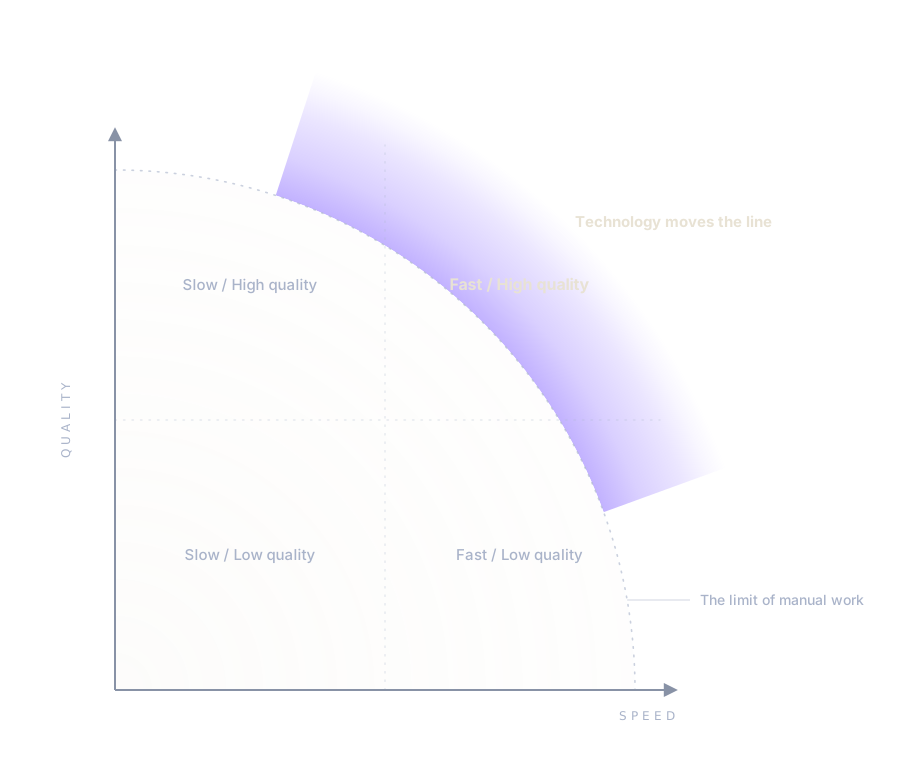
QUALITY × SPEED — technology takes us into the fast, high-quality zone
Legacy × Frontier
Proven foundations, combined with new AI.
In July 2026, the High Speed, High Quality system entered its second generation. The robust systems we have refined since founding, our systematized operations, a set of automation tools, and the patents that back them. To this proven foundation we added today's AI.
This is neither a switch to AI nor life support for an old system. Because we have the foundation we built up, we can use the latest AI safely and draw out its performance.
GEN 2 — 01 Foundation
harness
From access control to separating memory for each client. We design the solid footing that lets AI run safely ourselves. It is the most important part of the second generation. People stand outside it and use the harness.
GEN 2 — 02 Content
skills
Our own templates that make AI reproduce our work procedures exactly. The know-how we systematized in the macro era became the textbook for AI as it was. These templates are managed in three layers: rules shared by everyone in the firm, standards by client and by field, and the refinements of the attorney in charge. The structure itself prevents variation in quality.
GEN 2 — 03 Automated processing
agents
Several skills combine and carry the work forward on their own. At the entrance they gather the data needed to draft documents. At the exit they check for typos, missing descriptions, and whether each client's rules are followed. The machine makes a first pass before the patent attorney examines the work.
The division of roles is clear. A patent attorney sets the direction for the claims and drawings and the skeleton of the specification, AI drafts along that direction, and the patent attorney examines it and completes it.We never deliver AI output as it is.The density of quality checks, the coverage of searches, the speed of response. All of them now go beyond what we had before.
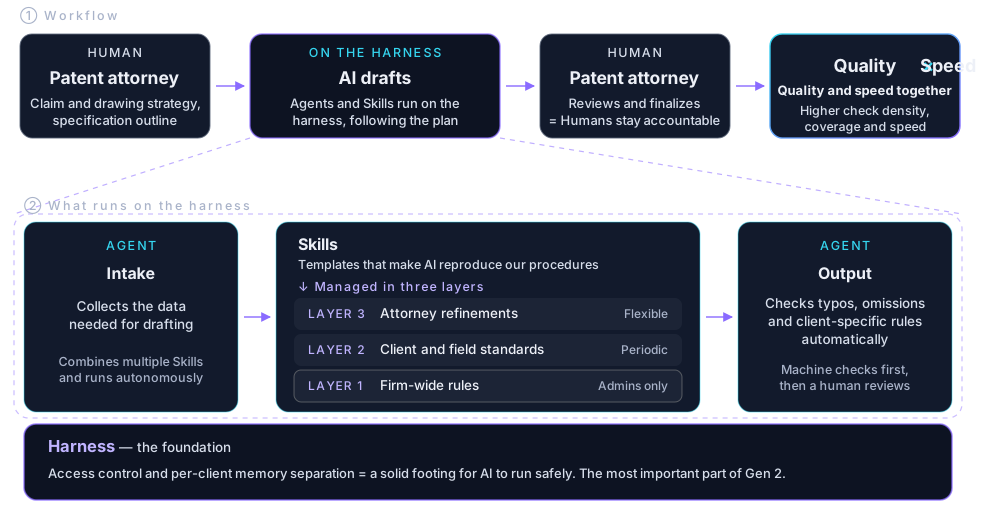
GEN 2 OVERVIEW — the harness at the base / agents at the entrance and the exit / direction and responsibility with people
The aim is to raise quality and speed at the same time. Efficiency is only the means. Our thinking has not changed since the macro era. What changed is the performance of the tools.
Inside GEN 2
Two structures that support quality.
Inside the second generation, two structures support quality. The layered structure that prevents variation in the content (skills), and memory management that separates client information at the base (the harness). So that quality does not rest on the performance of AI, we design the structure that runs it.
ARCHITECTURE 01
Layered structure: strict at the base, flexible at the front line
We manage our work templates in three layers. The bottom Layer 1 holds the common rules everyone in the firm follows, and only administrators can change them. On top of it we stack standards by client and by field, and the refinements of the attorney in charge. The structure itself prevents variation in quality.
ARCHITECTURE 02
Memory management: kept separate for each client
The memory AI refers to is kept separate for each client. Information from one case never mixes into work for another client. Together with access control, it forms the core of the harness.
A dedicated memory for each. They cannot reference one another.
AI Governance
We have rules for how we use AI.
The second generation runs on seven rules. These are the items set out in our published AI Guidelines, listed as they are.
- 01
Strict control of behavior through configuration files set in detail by administrators
- 02
Limits on AI access to internal systems, separated per user
- 03
Firm-wide sharing of skills and the like
- 04
Memory management that prevents contamination between information
- 05
MCP integrations kept to the minimum necessary
- 06
A robust harness that includes the above
- 07
One-on-ones with every member of the firm on adopting AI, plus frequent AI training and exchange sessions
The Operating System
IPX HUB We built our core internal system ourselves.
IPX HUB is the core system that lets us work across all internal data: cases, documents, communications and more. The High Speed, High Quality system that supports document drafting runs on it too. We built it ourselves as the information platform for the whole firm.
By adding a context layer that organizes the structure of the data, fast search across all data became possible. On top of it we combine a sophisticated rule base generated by AI, which raises the precision of processing. That precision was hard to reach by hand.
On this platform, several AI agents run at the same time and have greatly reduced the share of manual work.
AGENT 01
Automatic filing of email
Incoming email is sorted and filed automatically by case and by category.
AGENT 02
Automatic routing of new requests
New request emails are forwarded automatically to the relevant chat, and candidates for the person in charge are proposed.
AGENT 03
Automatic processing of JPO documents
Documents received from the Japan Patent Office are filed automatically, and the references cited in an office action are downloaded automatically.
AGENT 04
Status tracking
From the docketing system, the history of submissions to the Japan Patent Office, and email exchanges, changes in case status are recorded in detail.
AGENT 05
Automatic dashboard updates
From the history of submissions to the Japan Patent Office and the invoicing system, a dashboard with data such as revenue and the number of filings is updated automatically every day.
AGENT 06
Monitoring of specific companies
When an IP gazette from a designated company is published, it is detected and summarized, and the related service is identified. New service announcements from that company are detected automatically as well.
AGENT 07
Information gathering
For a given topic, news and IP information are collected every day and the important ones are posted to chat.
AGENT 08
A briefing every morning
It checks the calendar, email, chat and the case management system, organizes what needs attention, and posts it to chat every morning.
AGENT 09
Collecting information related to a case
Information related to a case is collected automatically and presented as reference.
AGENT 10
Conflict checks
When an inquiry arrives through the contact form, it compiles a report on whether a conflict of interest applies, taking the technical content and the business into account.
Various other agents are running besides these.
The agents learn from human corrections. We built in a self-improving mechanism that fits our operations better the more it is used.
LOOP 01 — learning where files go
If a file is stored in the wrong place, a person simply moves it to the right one. The AI remembers that action and makes the same judgment from then on.
LOOP 02 — automatic triage of defects
Of the defects reported in chat, minor ones are fixed automatically by AI. Complex ones are sent to the IT staff as a ticket.
Improvement does not come from AI learning alone. Through regular updates by designated members, a refinement someone found keeps reaching everyone in the firm instead of staying with one person. It is a mechanism that keeps being polished by collective knowledge.
STATUS
A new way to manage work, in place of a kanban board.
It also carries a status function for managing the progress of each case.
Colorful Specification
Colorful Specification An invention for the people who review.
From here on, this is about a mechanism we have refined since the first generation. The claims and the corresponding passages in the specification are automatically given the same color. That alone greatly reduces the burden on the people who check the documents.
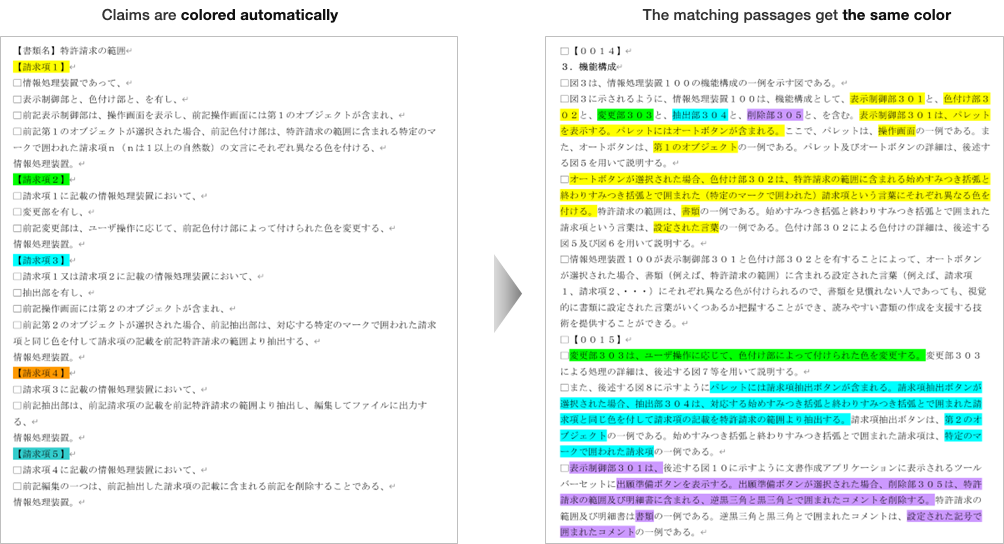
SAMPLE — Patent No. 6709924 (from the patents we hold)
EFFECT 01
The breaks between claims are visible at a glance.Color shows where one right ends.
EFFECT 02
Supporting passages are found instantly.It greatly reduces the review effort for inventors and IP staff.
EFFECT 03
Missing support is prevented structurally.Combined with our operations, it prevents claims from lacking support.
UPDATE
Documents from cases taken over midway can become Colorful Specifications too.
We integrated the existing set of macros with the new system and added new functions as well. Documents that had no color to begin with, such as cases taken over midway from another firm, can now have the Colorful Specification mechanism applied afterward.